
Learn · Gateways & backhaul
Gateways and backhaul: the part of the network that needs power and internet.
A LoRaWAN gateway is a simple radio-to-internet bridge, and the internet side is where networks succeed or fail. This guide covers choosing and placing gateways, powering them, and getting their data out over Ethernet, Wi-Fi, cellular, point-to-point wireless bridges or satellite.
Gateway hardware · placement and power · Ethernet · Wi-Fi · cellular · wireless bridges · satellite
At a glance
The numbers that matter.
What a gateway actually does
A LoRaWAN gateway is a radio-to-internet bridge. It listens on all of the network's channels at the same time, time-stamps every packet it hears, and forwards each one to the network server over whatever internet connection it has. It does not pair with devices, does not decrypt anything and does not store data. That simplicity is the point: a gateway can fail, be replaced or be added without touching a single sensor, and any sensor in range of two gateways is heard by both.
Because the gateway is the only piece of a LoRaWAN network that needs power and internet, most of the engineering in a deployment goes into where it sits, how it is powered and how it gets its packets to the cloud. That last part is the backhaul, and it decides whether a network is reliable or merely installed.
Choosing gateway hardware
- Indoor gateways are small, plug into a wall outlet and use Ethernet or Wi-Fi. Good for a single building, a mechanical room or a pilot. Their antennas are inside, so coverage stops at the walls.
- Outdoor gateways are sealed, powered over Ethernet or from solar, and mount on a mast, pole or wall with an external antenna. They cover miles and are what we install for campuses, courses, districts and utilities.
- Channel count. Eight-channel gateways are the workhorse. Sixteen- and sixty-four-channel units handle dense deployments with thousands of devices, or the full North American channel plan.
- Carrier-grade vs. hobby-grade. We specify gateways with industrial temperature ratings, surge protection, a real-time clock and remote management, from makers such as Kerlink, MultiTech, Tektelic, RAK and Milesight. A gateway you cannot reach remotely is a truck roll waiting to happen.
Placement, antennas and power
Height matters more than transmit power. A gateway antenna above the roofline, clear of HVAC units and parapets, can double the usable range of one mounted at eye level. We survey each site with a test gateway and a walking sensor before committing to a location, then specify the antenna gain, the cable and connectors (every foot of coax costs signal), a lightning arrestor and a proper ground.
Power comes from Power over Ethernet where a switch is nearby, from a local outlet with a surge-protected supply, or from a solar panel and battery bank where there is nothing. A solar site is sized for the worst month of the year at that latitude, not the average, so the gateway keeps reporting through a week of overcast. Our field photos of a solar pole site with its battery enclosure are on the network design page.
Backhaul options
Ethernet
The first choice whenever it exists. A wired connection is the fastest, lowest-latency and most reliable path, and Power over Ethernet carries power on the same cable. We work with the customer's IT team on a VLAN or firewall rule so the gateway reaches only the network server, and nothing on the corporate network can reach the gateway.
Wi-Fi
Convenient for indoor gateways and pilots, and the option we trust least for production. Wi-Fi networks get re-keyed, access points get replaced, and the gateway silently drops offline. When Wi-Fi is the only path we use a dedicated SSID, a static reservation and alerting on the gateway's heartbeat.
Cellular
For rooftops, poles and remote sites with no wiring, a gateway with a built-in cellular modem or an external router is the standard answer. Ordinary LTE gives the most bandwidth; LTE-M is enough for a gateway's traffic and draws less power on solar sites. We use IoT data plans with a private APN and, where uptime matters, multi-carrier SIMs that fail over to a second network.
Wireless bridges
When a gateway needs to sit on a pump house, a light pole or a maintenance building a few hundred feet to a few miles from the nearest Ethernet, a point-to-point wireless bridge carries the wire across the gap. A pair of directional 5 GHz radios with line of sight moves hundreds of megabits with a few milliseconds of latency, at a one-time cost and no monthly plan. We use them to reach the far end of a course, an outbuilding across a parking lot, or a second site across a road. They need clear line of sight, solid mounts and lightning protection, and they are worth it when the alternative is a cellular plan forever.
Satellite
For ranches, remote well pads and sites outside any cellular footprint, a low-earth-orbit satellite terminal such as Starlink gives a gateway a real internet connection almost anywhere with a view of the sky. It draws more power than cellular, so it is usually paired with mains or a larger solar array.
How we pick
| Backhaul | Best for | Watch out for | Ongoing cost |
|---|---|---|---|
| Ethernet / PoE | Any site with a switch within cable reach | IT change control, cable runs over 300 ft | None |
| Wi-Fi | Indoor gateways, pilots | Password changes, AP replacement, silent dropouts | None |
| Cellular LTE / LTE-M | Rooftops, poles, remote sites | Coverage inside enclosures, plan overages | Monthly plan |
| Wireless bridge | Outbuildings, far ends of a property | Line of sight, mounting, lightning | None after install |
| Satellite | Sites with no cellular at all | Power draw, sky view, weather | Monthly plan |
Most of our networks mix these. A campus might have a PoE gateway on the main building, a bridge to a gateway on the athletic fields, and an LTE-M gateway on a solar pole at the far property line.
Keeping gateways alive
- Heartbeat monitoring. Every gateway reports its status; a gateway silent for more than a few minutes raises an alert before customers notice missing data.
- Remote management. Firmware, configuration and reboots are done from the network server console, not from a ladder.
- Redundant coverage. Where a site cannot tolerate an outage, two gateways overlap so a single failure loses nothing.
- Security. Gateways talk to the network server over TLS or a VPN, sit behind a firewall, and never expose a management port to the internet.
These are the operating practices behind our managed support service.
In the field
Facility, infrastructure and outdoor municipal sites.
The same network layer, built three ways depending on what the site offers.
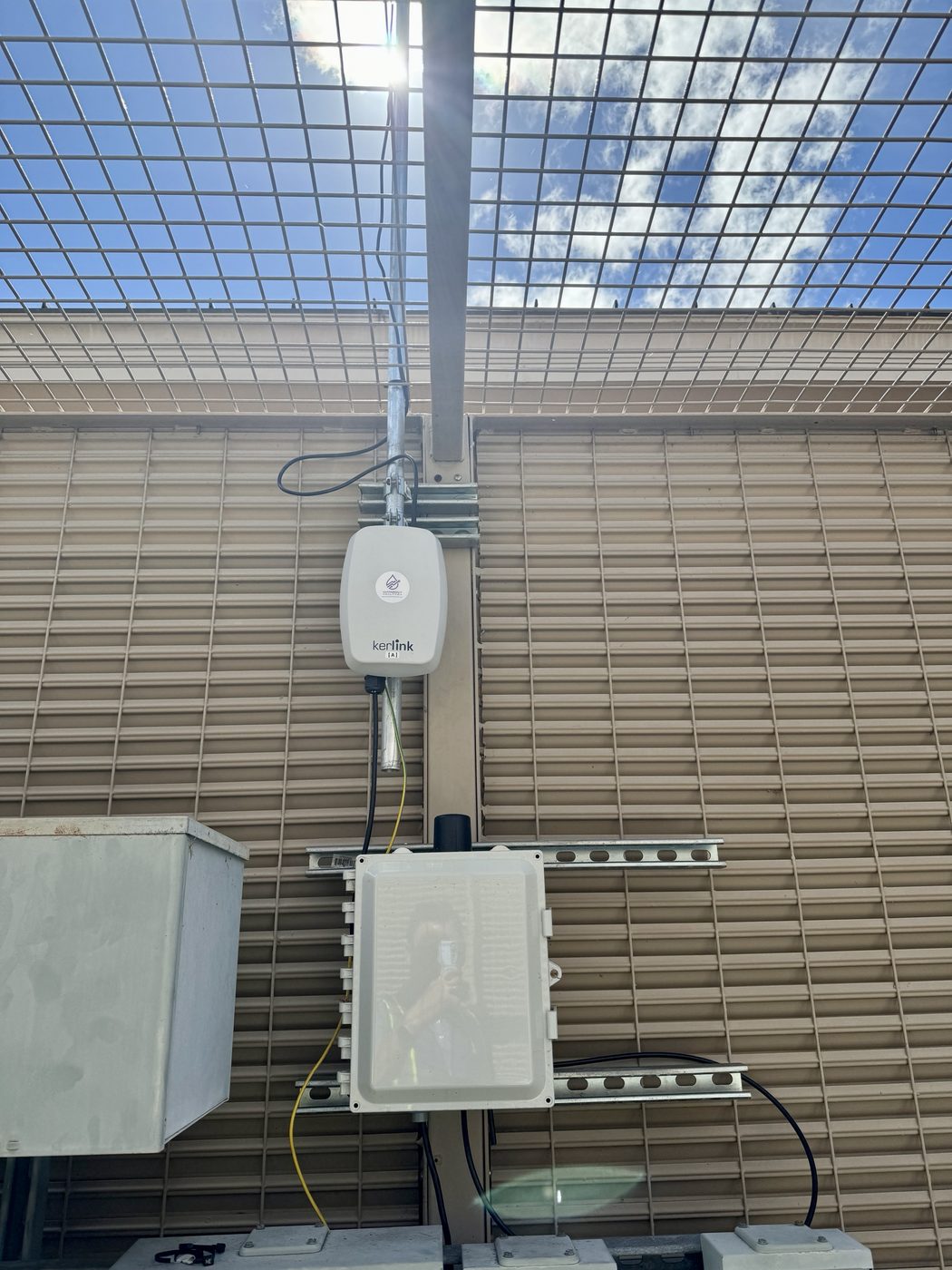
Rooftop equipment screen
PoE gateway on strut behind the screen, antenna above the roofline, surge protection and ground.
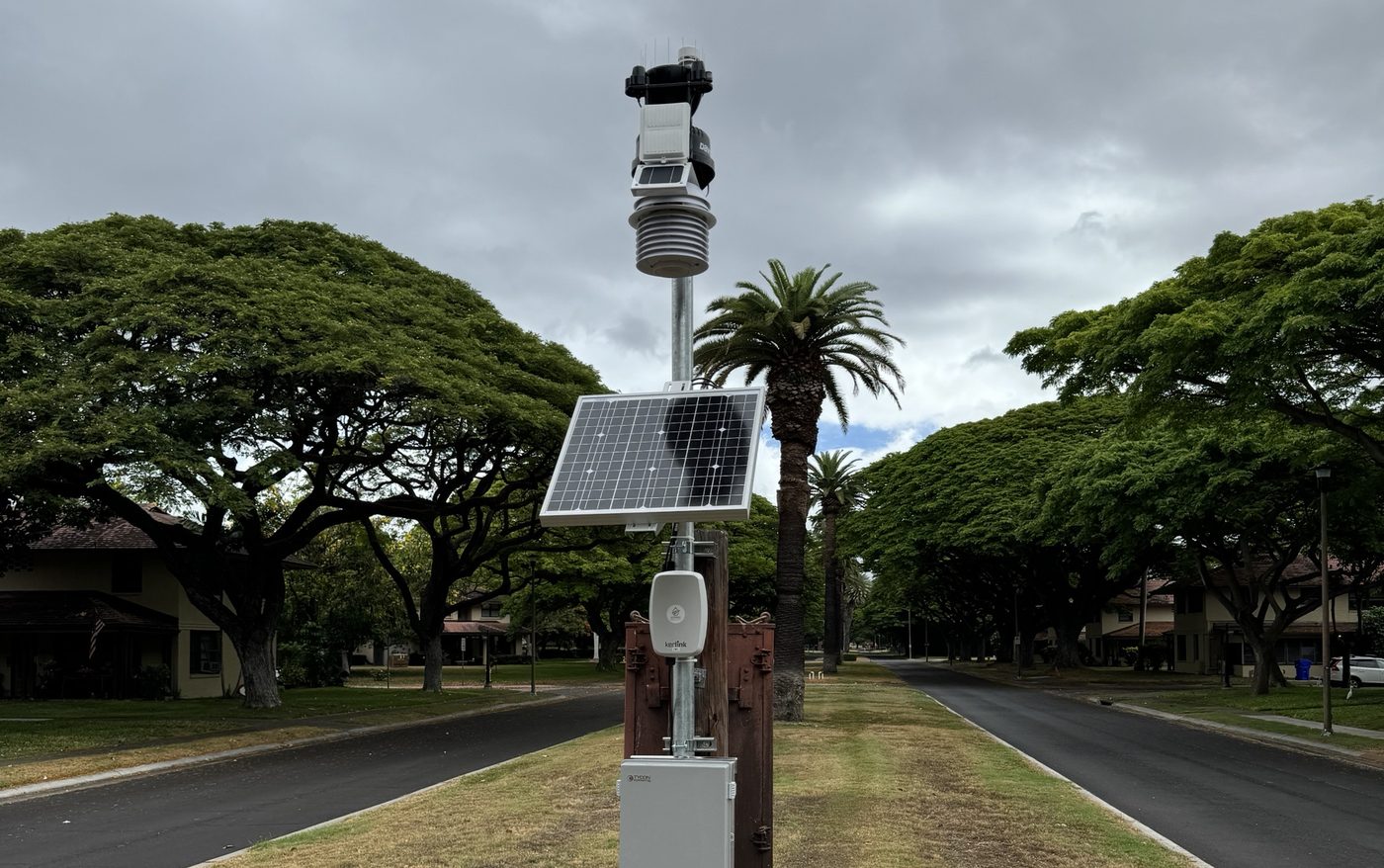
Solar pole site
Gateway, solar array and weather station on one pole in a median, with LTE-M backhaul and no trenching.
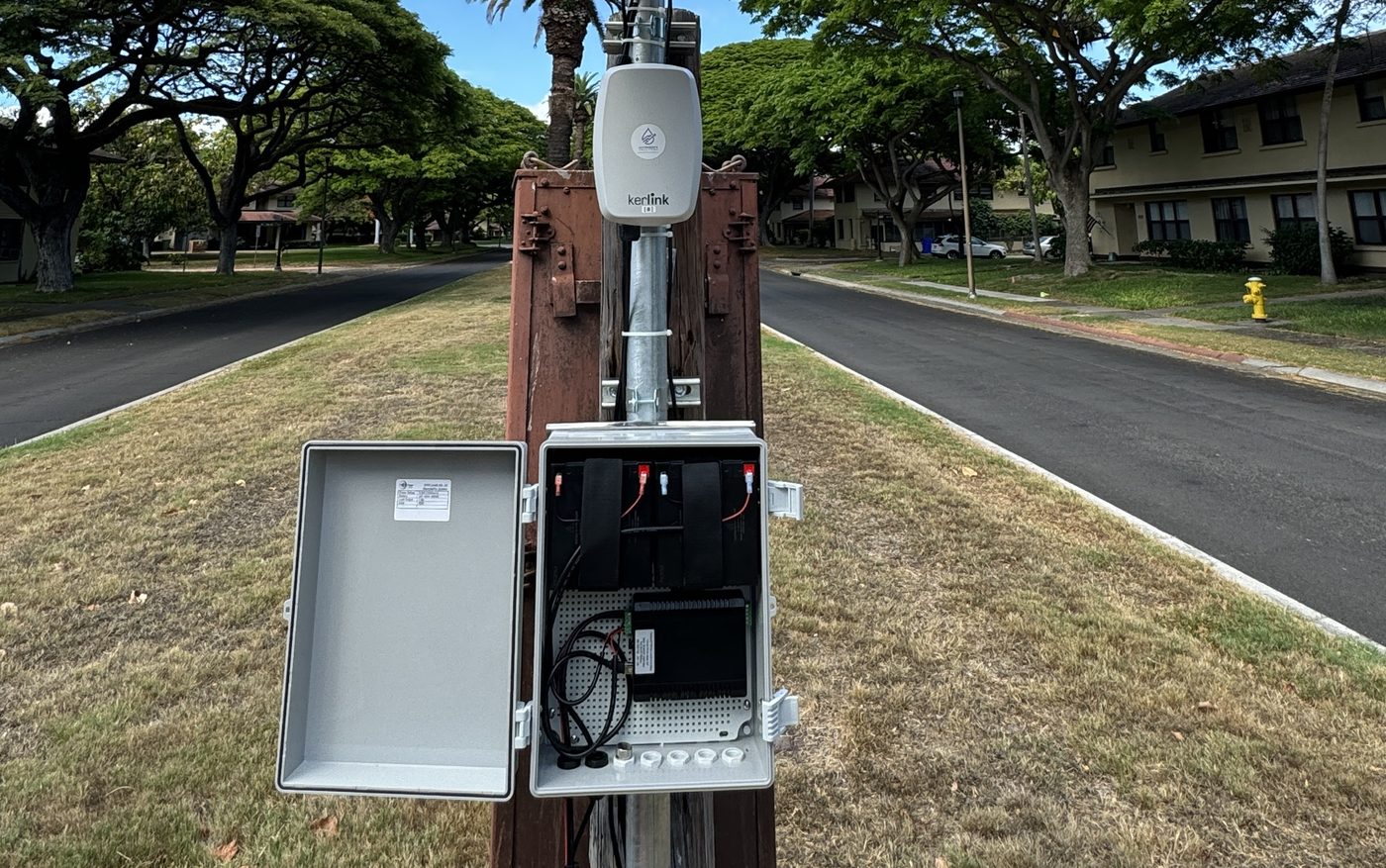
Battery enclosure
Deep-cycle batteries and a charge controller in a sealed enclosure, sized for the darkest month.
Can I put the gateway on my corporate network?
Yes, and we prefer wired. We work with your IT team on a VLAN or firewall rule so the gateway reaches only the network server and nothing on the corporate network can reach the gateway.
Is Wi-Fi good enough?
For an indoor gateway or a pilot, yes. For production we avoid it when we can, because password changes and access point swaps take gateways offline silently. If Wi-Fi is the only path we use a dedicated SSID and alert on the gateway heartbeat.
When does a wireless bridge make sense?
When a gateway needs to sit a few hundred feet to a few miles from the nearest Ethernet with clear line of sight, such as a pump house, a far athletic field or an outbuilding. It is a one-time cost with no monthly plan.
How much cellular data does a gateway use?
Very little. A gateway forwarding a few hundred sensor reports an hour uses tens of megabytes a month, well within an IoT data plan. LTE-M is enough on solar sites; ordinary LTE gives headroom for firmware updates.
What happens when a gateway goes down?
Sensors in range of a second gateway are unaffected. Where a site cannot tolerate an outage we overlap coverage, and every gateway reports a heartbeat so we know within minutes, before data goes missing.
Harmony Analytica
Need a gateway somewhere without power or internet?
Tell us where. We will design the mount, the power and the backhaul, and quote it at a fixed fee.